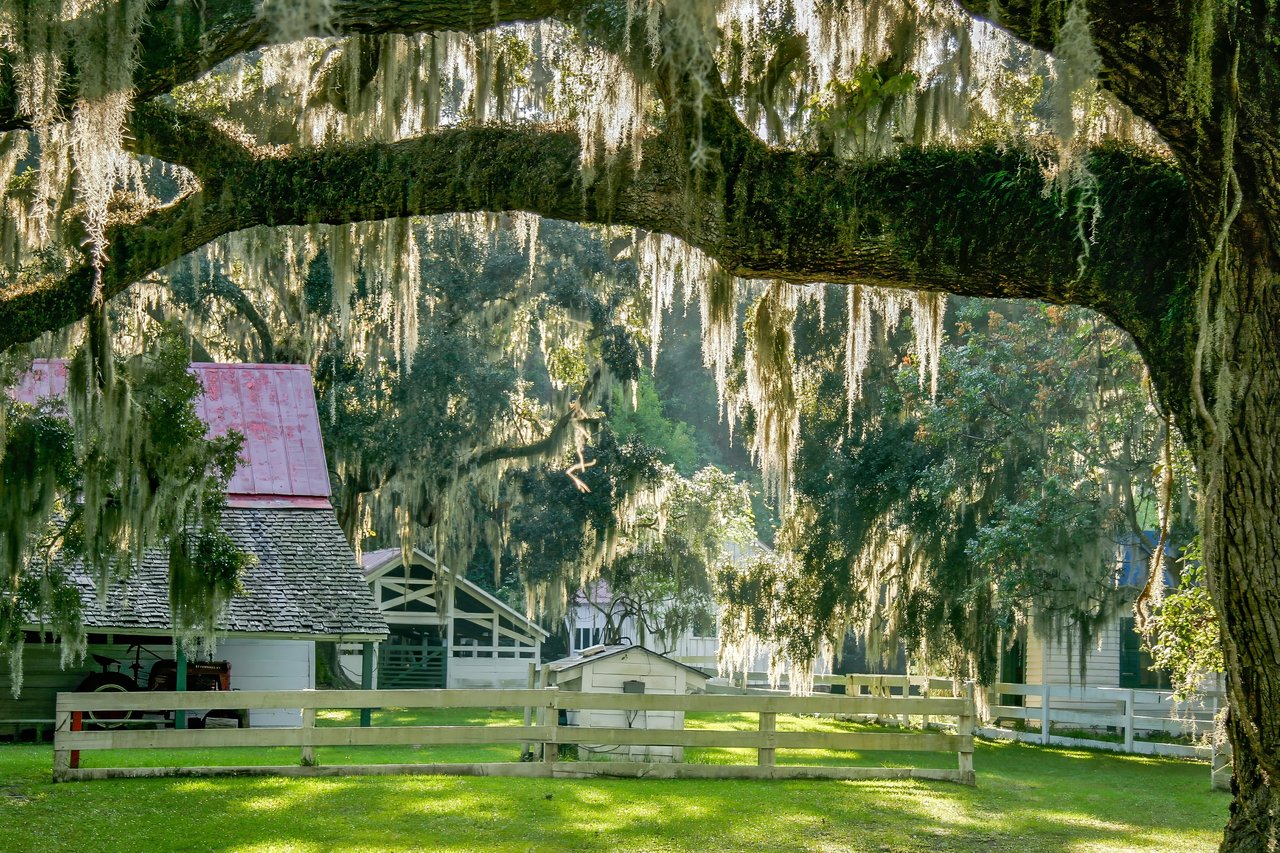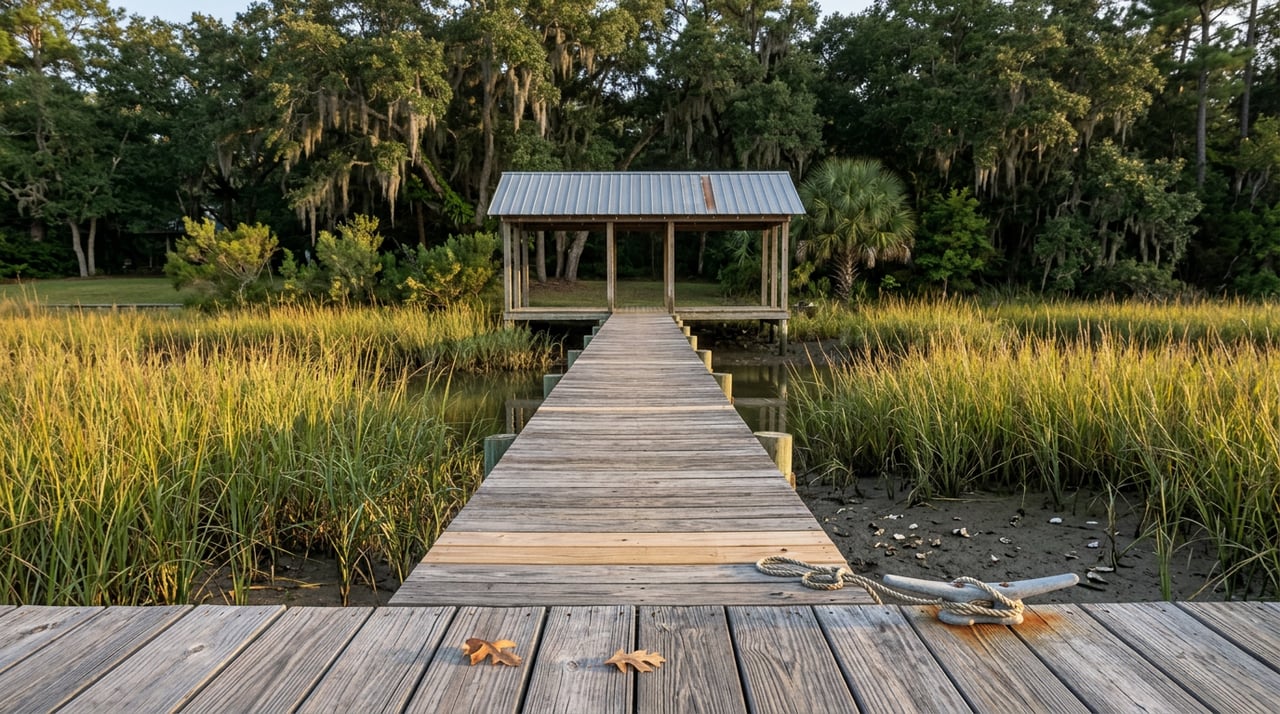
Drive to the end of Islands Highway toward the Medway River and the map still tells you that you have arrived in Sunbury. Get out of the car and look around. There is no town. No grid of streets, no storefronts, no town square. What is actually there is a marsh view, a low earthen wall, a cemetery, and if you keep driving another few minutes, a marina with a seafood restaurant that runs a wait list on Saturday nights. The name has outlasted the place it was named for by roughly two and a half centuries.
That gap between the name on the map and what is physically standing is the whole reason a weekend here works the way it does, and it is worth understanding before you plan one.
A Port That Rivaled Savannah, Then Simply Wasn't
In 1758, a settler named Mark Carr laid claim to 500 acres on a bluff above the Medway River and platted a new port town he called Sunbury. The plan was ambitious for its time: 496 lots, three public squares named Kings, Church, and Meeting, and five wharves along a river deep enough, at more than 40 feet in places, to dock ocean-going ships, according to Sherpa Guides' history of Liberty County. For a few decades it worked. Sunbury shipped rice, indigo, animal skins, lumber, tar, and rosin out to the world, and the Liberty County Historical Society describes it as a city center that once rivaled Savannah before the Revolutionary War, in its own video history of the area.
The Revolutionary War ended that run. British land forces marched toward the area in 1778 and burned Midway Church and nearby plantations along the way, though the accompanying naval commander ultimately chose not to attack Fort Morris or the town of Sunbury directly. The fort saw one more chapter of use during the War of 1812, when the earthworks were manned again under the name Fort Defiance. After that, Sunbury was never rebuilt. The Liberty County Historical Society puts it plainly in its own account of the town: what remains today of the original settlement is the cemetery and Fort Morris, nothing else.
That is the piece almost nobody spells out. The neighborhood carries a colonial name, but the colonial town is gone. Everything you can actually walk into today is either a memorial to that disappearance or something built later that borrowed the name because the location still mattered.
Fort Morris Is the Only Thing Standing Where the Wharves Were
The earthworks at Fort Morris State Historic Site are the closest thing to physical continuity with 1758 Sunbury. The fort was built to protect the seaport and the strategic Medway River, and the original bastion was garrisoned by 200 patriots during the Revolution. Today visitors walk the same preserved earthworks while looking out over St. Catherines Sound, and a small museum tells the rest of the story with a short film.
Because the fort sits on marsh-edge high ground, it doubles as one of the better birding spots in the area. The state park lends out binoculars and a field guide, and the species list includes downy woodpeckers, pileated woodpeckers, goldfinches, wood storks, painted buntings, and great egrets, per the Georgia State Parks page for Fort Morris. The historic site is open seven days a week from 9 a.m. to 5 p.m., with the museum staffed Friday through Sunday. Monday through Thursday it runs on the honor system, five dollars a vehicle into a collection box in the parking lot.
The 2026 calendar adds a reason to time a visit around something specific rather than dropping in cold. Fort Morris has an Independence Day commemoration at Colonial Sunbury on the books for September 5, 2026, and a "Come and Take It!" Encampment and Wreath Ceremony set for November 21, 2026, according to the Explore Georgia events listing for Midway. A Labor Day Celebration is also on the site's 2026 calendar, though the listing does not spell out its exact date, so it is worth confirming before you build a Saturday around it.
Sunbury Then and Now
| What it was in 1758 | What occupies the same footprint today |
|---|---|
| A platted town of 496 lots, three public squares, and five working wharves | A cemetery and the grass-covered earthworks of Fort Morris |
| A seaport shipping rice, indigo, skins, lumber, tar, and rosin | Sunbury Crab Company, a marina and restaurant on the same channel |
| A fort garrisoned by 200 patriots defending river trade | Fort Morris State Historic Site, a museum and self-guided trail |
| Pine plantation land owned by Union Camp Corporation for paper production | Cay Creek Wetland Interpretive Center, a boardwalk through six habitats |
The Land That Used to Feed Paper Mills Is Now a Boardwalk
A few miles inland, Cay Creek Wetland Interpretive Center sits on land that spent most of the 20th century as industrial pine forest. Union Camp Corporation, one of the paper companies that worked the South's timber, owned the acreage before the City of Midway bought it in 1996 specifically to give residents a place to learn about coastal ecosystems, according to Georgia Coast Atlas. That is a genuinely different origin story than the fort. Cay Creek was never a town or a battlefield. It was a commodity crop that got turned into a park.
What is there now is an elevated boardwalk crossing six distinct habitats, from maritime forest and pine flatwood through freshwater tidal swamp into brackish tidal marsh, with 20 interpretive panels along the way and a 15-foot tower built for birding. More than 80 bird species have been documented on site, and the park counts over 100 different plant and tree species inside its boundary. It is one of nine stops on Midway's Liberty Trail, a "25 mile route [that] passes through 9 historic, cultural, and natural sites," as One Hundred Miles describes it, linking Cay Creek to Fort Morris and Melon Bluff along a single corridor. The park is free, open year-round, and dog friendly, with public restrooms on site at 189 Charlie Butler Road.
The City of Midway also runs its own Midway Day Festival at Cay Creek most springs, typically as part of the statewide Georgia Cities Week, with food, music, and games for residents, per Liberty County's own city guide. Exact dates shift year to year, so treat it as an annual habit worth watching for rather than a fixed calendar entry.
Sunbury Crab Company Sits Where the Trade Ships Used to Dock
The last piece of the loop is the only business actually inside old Sunbury's boundaries, and it leans into that history without overselling it. Sunbury Crab Company is a family-run restaurant and marina on Sunbury Channel, owned and operated by Barney and Elaine Maley with their sons Clay and Joe. It is reachable by car down Brigantine Dunmore Road or by boat straight up the Medway River, the same channel that once carried rice and indigo out to open water.
The menu runs on steamed blue crab caught by the restaurant's own boats, wild-caught Georgia shrimp, and Ossabaw oysters in season, alongside steaks and burgers for anyone who wanted the water view without the seafood, per the restaurant's own site. It seats enough people that a Saturday crowd rarely means a long wait, but reservations are still the safer move, especially for a table with a river view. Live music runs through the week, and the marina has more than 100 boat slips, which tells you plainly that a fair share of the regulars arrive by water rather than road.
A Realistic Saturday
- Start at Cay Creek Wetland Interpretive Center in the morning, when birding is best and the boardwalk is coolest. Bring your own binoculars if you have them, though the park's own tower does not require one.
- Drive the short stretch to Fort Morris State Historic Site before midday. Walk the earthworks, catch the museum if it is a Friday through Sunday visit, and check ahead if you are timing the trip around a 2026 living-history event.
- Finish at Sunbury Crab Company for a late lunch or early dinner. Call ahead for a reservation, particularly if a river-view table matters to you, and check the week's live music schedule before you go.
Good to Know Before You Go
- Cay Creek Wetland Interpretive Center: 189 Charlie Butler Road, Midway, free admission, open year-round, dog friendly, public restrooms on site.
- Fort Morris State Historic Site: open daily 9 a.m. to 5 p.m., museum staffed Friday through Sunday, five dollars per vehicle for self-guided visits Monday through Thursday.
- Sunbury Crab Company: closed Monday and Tuesday, reservations recommended, reachable by both road and water.
None of these three places are new. What is worth noticing is how little overlap there is between them in purpose and how tightly they still sit inside a few square miles that once made up a single working port town. A resident who treats them as three separate errands misses the pattern. A resident who treats them as one loop, built on the same ground the wharves once occupied, gets a Saturday that actually explains why the name Sunbury never left the map even after the town did.
If you are already living somewhere along this stretch of Coastal Georgia and want more of this kind of local detail, or if you have questions about the neighborhoods further down the coast, the Teresa Cowart Team is always glad to talk. Let's Connect.